
Apostolic Letter In unitate fidei on the occasion of the 1700th anniversary of the Council of Nicaea
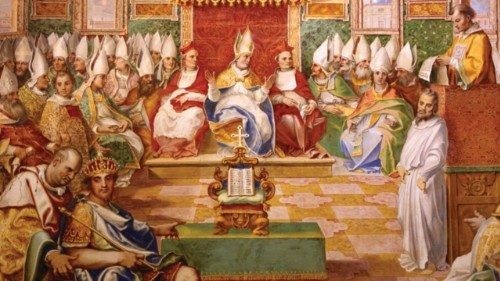
On 23 November, a few days before his apostolic journey to Turkey on the occasion of the 1700th anniversary of the Council of Nicaea, Pope Leo XIV published an Apostolic letter entitled In unitate fidei, which contains numerous ecumenical reflections.
In particular, the Holy Father states in n. 12:
Finally, the Council of Nicaea is relevant today because of its great ecumenical value. Indeed, the achievement of unity among all Christians was one of the main objectives of the last Council, the Second Vatican Council. Exactly thirty years ago, Saint John Paul II further promoted this conciliar message in his Encyclical Ut Unum Sint (25 May 1995). In this way, together with the great anniversary of the First Council of Nicaea, we also celebrate the anniversary of the first ecumenical Encyclical. It can be considered a manifesto that brought up to date the same ecumenical foundations laid down by the Council of Nicaea.
Thanks to God, the ecumenical movement has achieved much in the last sixty years. It is true that full visible unity with the Orthodox and Oriental Orthodox Churches and with the ecclesial communities born of the Reformation has not yet been reached. Nevertheless, ecumenical dialogue, founded on one baptism and the Nicene-Constantinopolitan Creed, has led us to recognize the members of other Churches and ecclesial communities as our brothers and sisters in Jesus Christ, and to rediscover the one universal community of Christ’s disciples throughout the world. We share the same faith in the one and only God, the Father of all people; we confess together the one Lord and true Son of God, Jesus Christ, and the one Holy Spirit, who inspires us and impels us towards full unity and the common witness to the Gospel. Truly, what unites us is much greater than what divides us! In a world that is divided and torn apart by many conflicts, the one universal Christian community can be a sign of peace and an instrument of reconciliation, playing a decisive role in the global commitment to peace. Saint John Paul II reminded us, in particular, of the witness of the many Christian martyrs from all Churches and ecclesial communities: their memory unites us and spurs us on to be witnesses and peacemakers in the world.
In order to carry out this ministry credibly, we must walk together to reach unity and reconciliation among all Christians. The Nicene Creed can be the basis and reference point for this journey. It offers us a model of true unity in legitimate diversity. Unity in the Trinity, Trinity in Unity, because unity without multiplicity is tyranny, multiplicity without unity is fragmentation. The Trinitarian dynamic is not a dualistic and exclusive “either/or,” but rather a decisive bond, “both/and.” The Holy Spirit is the bond of unity whom we worship together with the Father and the Son. We must therefore leave behind theological controversies that have lost their raison d’être in order to develop a common understanding and even more, a common prayer to the Holy Spirit, so that he may gather us all together in one faith and one love.
This does not imply an ecumenism that attempts to return to the state prior to the divisions, nor is it a mutual recognition of the current status quo of the diversity of Churches and ecclesial communities. Rather, it is an ecumenism that looks to the future, that seeks reconciliation through dialogue as we share our gifts and spiritual heritage. The restoration of unity among Christians does not make us poorer; on the contrary, it enriches us. As at Nicaea, this goal will only be possible through a patient, long and sometimes difficult journey of mutual listening and acceptance. It is a theological challenge and, even more so, a spiritual challenge, which requires repentance and conversion on the part of all. For this reason, we need the spiritual ecumenism of prayer, praise and adoration, as expressed by the Creed of Nicaea and Constantinople.